
Pakistan Unrest 2026: Balochistan Violence and POK Protests Put Islamabad Under Pressure
Pakistan unrest 2026
Pakistan's Independence Day celebrations on August 14, 2026, are unfolding against a sharply contrasting security and political backdrop.
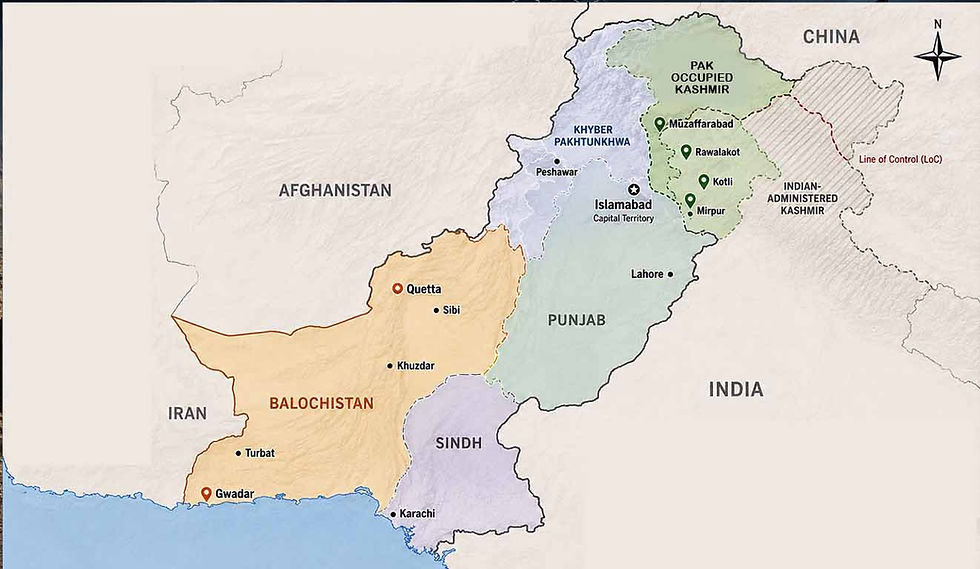
While official ceremonies are taking place across the country, Balochistan and POK are experiencing two very different forms of instability — an entrenched armed insurgency in the southwest and a politically driven protest and electoral crisis in Kashmir.
The developments should not be treated as a single movement. Their histories, participants, demands and methods are fundamentally different.
But taken together, they demonstrate the range of internal pressures confronting Pakistan at a politically sensitive moment.
Pakistan's government has used Independence Day to emphasise national unity and stability. Prime Minister Shehbaz Sharif and other leaders issued messages calling for cohesion, security and economic progress.
At the same time, security incidents in Balochistan and continuing unrest in Pakistan Occupied Kashmir tell a more complicated story.
Pakistan unrest 2026 has emerged as a broader security and political story, with developments in Balochistan and POK highlighting two very different challenges confronting Islamabad.
What is happening in Balochistan?
Balochistan has experienced a long-running separatist insurgency, but violence has intensified significantly during 2026.
The Balochistan Liberation Army, or BLA, and other armed groups have targeted Pakistani security personnel, police, government facilities and infrastructure.
Earlier this year, coordinated attacks hit Quetta and numerous other towns across the province. Pakistani authorities said 15 security personnel and 18 civilians were killed, while the military reported killing 92 militants during its response.
The violence formed part of a broader escalation that analysts have described as one of the most serious security challenges Pakistan has faced in years.
The Soufan Center said this week that Pakistan is experiencing one of its deadliest years for terrorism-related fatalities since 2013, with violence associated particularly with the Pakistani Taliban, or TTP, and the BLA.
AT A GLANCE
Why August 14 matters in Balochistan
The timing gives the current developments additional political symbolism.
Some Baloch nationalist groups commemorate August 11 in connection with Balochistan's contested political history before Pakistan's creation.
This year, separatist narratives and demonstrations surrounding the date again appeared in public and diaspora campaigning.
More significantly for the immediate security situation, reports say the BLA called for August 14 to be observed as a “Black Day”, encouraging demonstrations and opposition to Pakistan's Independence Day celebrations.
That does not mean such calls represent the views of Balochistan's entire population. Baloch political opinion includes separatists, nationalists seeking greater provincial autonomy, mainstream political parties and citizens primarily concerned with governance, employment and development.
That distinction is important.
Fresh attack adds to Balochistan tensions
The security situation remained volatile around Independence Day itself.
On August 14, Balochistan Home Minister Mir Ziaullah Langove survived an armed attack on his convoy in Mastung district, according to reports. Six people, including three police personnel, were reported injured.
The incident illustrates how the current confrontation is not limited to remote insurgent strongholds.
Balochistan has experienced attacks against police, military forces, government officials, transport infrastructure and other targets.
WHY BALOCHISTAN MATTERS
The roots of the Balochistan conflict
The current confrontation cannot be understood solely through individual attacks.
Balochistan has experienced multiple insurgencies since Pakistan's creation.
Separatist and nationalist organisations have long argued that the province does not receive an equitable share of the wealth generated from its natural resources and have raised allegations concerning political marginalisation, enforced disappearances and military operations.
Pakistan's government rejects separatist claims and says armed organisations such as the BLA are terrorist groups responsible for attacks on civilians, security forces and infrastructure.
The BLA is designated as a terrorist organisation by several governments, including the United States.
The conflict therefore combines questions of nationalism, political representation, resources, security and regional geopolitics.
Pak Occupied Kashmir: a different crisis
Hundreds of kilometres northeast, Pakistan faces another challenge.
But what is happening in Pak Occupied Kashmir, officially called Azad Jammu and Kashmir (AJK) by Pakistan, should not be confused with the Baloch insurgency.
The current unrest is predominantly political and socioeconomic rather than an armed separatist campaign comparable with the BLA insurgency.
The Joint Awami Action Committee (JAAC) has emerged as a significant force in demonstrations demanding political and economic reforms.
Earlier protests included demands concerning electricity prices, flour subsidies and governance. More recently, disputes over political representation and elections have intensified tensions.
Deadly protests and election controversy
The crisis became particularly serious during the 2026 regional election period.
Reuters reported on August 10 that the final round of voting was postponed in seven constituencies because of security concerns following deadly protests and civil unrest.
According to Reuters, clashes following the first round of voting in late July reportedly left more than 30 people dead in Rawalakot.
The JAAC opposes electoral arrangements that reserve seats for refugees from Indian-administered Kashmir and alleges that Islamabad uses the system to influence regional politics.
Pakistani authorities reject allegations of electoral manipulation.
The Pakistan Muslim League-Nawaz had already secured 24 of 34 seats contested in earlier rounds and was positioned to form the regional government, Reuters reported. The Pakistan Peoples Party raised allegations of electoral irregularities, while candidates associated with former prime minister Imran Khan's PTI boycotted the vote over alleged rigging.
WHAT PROTESTERS ARE RAISING
Communications restrictions add another dimension
The confrontation has also involved restrictions on communications.
During unrest earlier this year, internet and mobile services were disrupted in parts of the territory. Dawn reported in June that an internet outage had entered its eighth day while demonstrations and strikes continued around Rawalakot.
The issue has subsequently gained an international dimension.
The Guardian reported this week on the death of a British national who was shot during clashes in Pakistan-administered Kashmir in June. His family said he was not participating in the protest and was struck near a demonstration. The UK Foreign Office has raised concerns with Pakistani authorities.
Pakistan has disputed allegations that its security forces deliberately targeted peaceful demonstrators.
Media restrictions raise transparency concerns
Reporting independently from areas experiencing unrest has also become more difficult.
Reuters reported on August 6 that Pakistan expanded restrictions governing foreign-media reporting by requiring Pakistani journalists and other local employees working with foreign outlets to obtain permission before travelling outside major cities for reporting assignments.
The restrictions came amid unrest in Pakistan-administered Kashmir and continuing insurgencies elsewhere in the country.
Human-rights organisations criticised the measures as potentially damaging to press freedom.
For readers following developments in Balochistan and Kashmir, this is important: claims from governments, militant organisations, protest groups and social-media accounts should all be independently verified whenever possible.
TWO FRONTS, DIFFERENT DYNAMICS
Why the two crises matter for Islamabad
Pakistan's immediate challenge is that these pressures are emerging simultaneously.
Balochistan requires extensive security resources because of the armed insurgency.
Pak Occupied Kashmir presents a different challenge because the dispute involves political legitimacy, governance and public protests.
The Kashmir unrest also carries diplomatic sensitivity.
Pakistan has traditionally criticised India's policies in Indian-administered Kashmir. Sustained political unrest on the Pakistan-Occupied Kashmir side therefore has implications beyond domestic politics.
Balochistan, meanwhile, carries significant strategic importance because of its geography, mineral resources, coastline and Chinese investment associated with the China-Pakistan Economic Corridor.
Independence Day exposes contrasting narratives
August 14 brings those contradictions into particularly sharp focus.
Across much of Pakistan, Independence Day is being celebrated with ceremonies, flags and public events. Associated Press reported large celebrations in Islamabad, while the country's leadership used the occasion to emphasise national unity and sovereignty.
Yet nationalist mobilisation in Balochistan and political demonstrations in Pakistan Occupied Kashmir present competing narratives about governance, representation and relations with the central state.
This does not mean Pakistan faces imminent territorial fragmentation.
It does mean Islamabad is confronting several difficult internal-security and political challenges simultaneously.
WHAT TO WATCH NEXT
The bigger picture
The events unfolding around Pakistan's 79th Independence Day illustrate two separate but consequential challenges to the state.
In Balochistan, Islamabad confronts a decades-old insurgency that has become increasingly capable of mounting coordinated attacks.
In Pakistan Occupied Kashmir, the challenge is principally political: protests, electoral disputes, economic grievances and demands for greater representation.
Conflating the two would obscure their very different origins.
But their simultaneous escalation matters.
For Pakistan's leadership, the central question is increasingly not simply how to contain unrest, but whether security measures can be combined with political solutions capable of addressing the grievances that sustain it.
For the region, developments in both territories will remain important indicators of Pakistan's internal stability through the remainder of 2026.


