
How Al-Qaeda Operates Today: Leadership, Funding and Global Affiliates
Updated: Sep 8
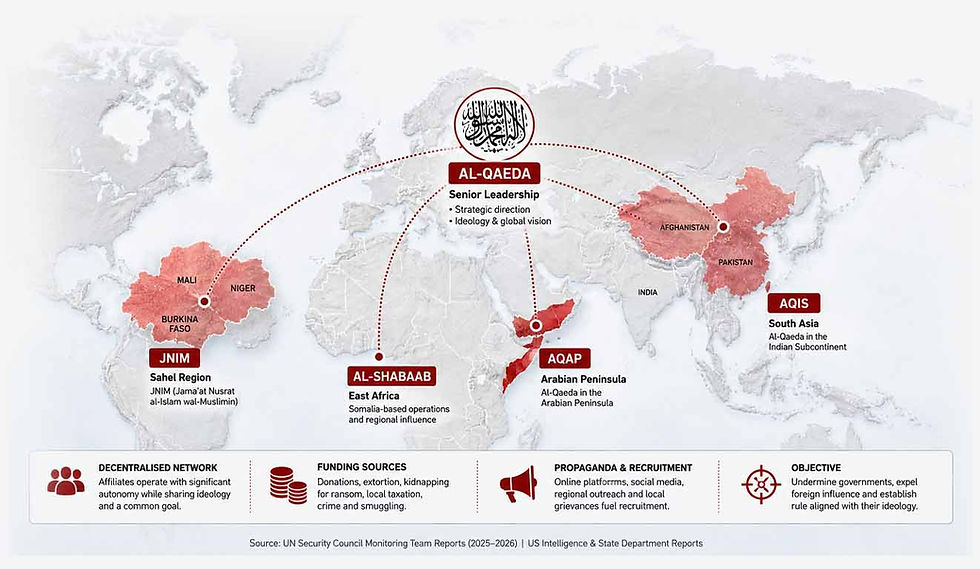
More than two decades after the September 11 attacks and years after the deaths of Osama bin Laden and Ayman al-Zawahiri, Al-Qaeda has not disappeared.
It has changed.
The organisation that once operated from Afghanistan under a highly visible leadership has evolved into a dispersed international network. Its central leadership is weaker and more isolated, while regional affiliates have become increasingly important, particularly across Africa and Yemen.
The United Nations described the terrorist threat in early 2026 as increasingly multipolar and complex. Al-Qaeda's leadership remained cohesive but isolated, while its regional branches continued to exploit conflicts, weak governance and local grievances.
That makes understanding modern Al-Qaeda more complicated than identifying one headquarters or one commander.
Today's network is better understood as a collection of interconnected organisations sharing ideology, historical relationships and strategic objectives, but often pursuing their own regional agendas.
How Al-Qaeda Operates Today
Al-Qaeda's transformation began long before the death of Ayman al-Zawahiri in a US drone strike in Kabul in July 2022.
Years of counterterrorism operations killed or captured many senior commanders, disrupted communications and weakened the organisation's traditional command structure.
But the network adapted.
Regional affiliates developed their own leadership structures, recruitment networks, financing systems and territorial ambitions.
The US National Counterterrorism Center has described Al-Qaeda as having evolved from its Afghanistan-Pakistan base into a dispersed network of affiliates and supporters, with much of its operational activity generated by regional branches.
The result is a network that can survive even when its central leadership is under intense pressure.
Who Leads Al-Qaeda Today?
This is one of the most complicated questions surrounding the organisation.
After Zawahiri's death, Al-Qaeda did not publicly announce a successor in the conventional way.
UN monitoring reports identify veteran Egyptian militant Sayf al-Adl as the organisation's de facto leader.
Al-Adl is believed to be based in Iran, a situation that creates political and operational complications for Al-Qaeda's leadership.
The UN's February 2026 assessment said the leadership remained cohesive but isolated, while dissatisfaction with Al-Adl's de facto leadership persisted among some members.
This does not mean Al-Adl necessarily controls every operation carried out by an Al-Qaeda affiliate.
That distinction is crucial.
The modern network gives its regional branches considerable freedom to respond to local political and security conditions.
And another centre of influence appears to be emerging.
AQAP Is Becoming Increasingly Important
Al-Qaeda in the Arabian Peninsula, or AQAP, has long been regarded as one of the network's most dangerous branches.
Based primarily in Yemen, AQAP has previously attempted attacks outside the country and developed sophisticated English-language propaganda aimed at international audiences.
The UN's 2026 assessment identified an important development: AQAP, under Saad bin Atef al-Awlaki, appeared to be increasingly asserting ideological and operational leadership of the global Al-Qaeda network.

The UN also assessed that the external threat posed by AQAP was increasing, although still opportunistic.
Its importance extends beyond battlefield operations.
AQAP's Al-Malahem Media Foundation and its Inspire publication remain significant propaganda instruments. UN monitors reported that the group continued to use global political events in its messaging and sought to reach Western audiences.
Al-Qaeda's Global Affiliate Network
The centre of gravity has increasingly shifted away from the organisation's historic Afghanistan-Pakistan heartland.
Today, some of the most powerful Al-Qaeda-linked organisations operate in Africa and the Arabian Peninsula.
Among the most significant are:
JNIM — Sahel
Jama'at Nusrat al-Islam wal-Muslimin (JNIM) has emerged as one of the most consequential Al-Qaeda affiliates.
Its operations are concentrated particularly in Mali, Burkina Faso and Niger, while its influence has pushed toward coastal West African states.
The UN reported in 2026 that JNIM had expanded its operations, opened new fronts and attacked not only military targets but also economic infrastructure, mining operations and strategic transport routes.
Its growing strength illustrates one of Al-Qaeda's most successful modern strategies:
attach a global ideology to a local conflict.
Al-Shabaab — Somalia and East Africa
Somalia-based Al-Shabaab is another exceptionally powerful Al-Qaeda affiliate.
It controls or influences territory, collects revenue and conducts attacks in Somalia and elsewhere in East Africa.
US intelligence has previously described Al-Shabaab as Al-Qaeda's largest, wealthiest and most lethal affiliate.
Unlike an underground terrorist cell dependent entirely on outside donations, Al-Shabaab has developed a sophisticated local economic system.
Taxes, extortion and other forms of revenue collection help sustain its operations.
US authorities have also targeted international financial networks accused of moving and laundering money on the group's behalf.
AQAP Yemen
AQAP remains active despite years of military and counterterrorism pressure.
The organisation has historically generated revenue through a combination of donations, robbery, kidnapping for ransom and exploitation of local economic opportunities.
Its importance now extends beyond Yemen because of its media capabilities and increasingly prominent position within the wider Al-Qaeda network.
AQIS South Asia
Al-Qaeda in the Indian Subcontinent (AQIS) was created to extend the organisation's influence across South Asia.
Its historical area of interest has included Afghanistan, Pakistan, India and Bangladesh.
Compared with major African affiliates, its operational footprint is considerably smaller, but the wider network continues to maintain interests in South Asia.
The region also remains important because of Al-Qaeda's historic connections to Afghanistan and Pakistan.
How Does Al-Qaeda Make Money?
There is no single global Al-Qaeda bank account financing every affiliate.
Its financial structure has become decentralised alongside its operational structure.
Different branches generate money according to the environments in which they operate.
Funding can include donations, extortion, taxation, kidnapping for ransom, criminal activity and exploitation of local commercial networks.
The UN notes more broadly that terrorist organisations can exploit legitimate businesses, natural resources, non-profit organisations, crowdfunding and criminal activity, while increasingly attempting to misuse modern financial technologies.
Al-Qaeda affiliates illustrate how locally generated revenue can reduce dependence on central leadership.
Kidnapping for Ransom
Kidnapping remains particularly significant in parts of Africa.
JNIM has used kidnapping for ransom as a revenue source.
The February 2026 UN Monitoring Team report said its coffers had been boosted by ransom proceeds and cited reports of a single ransom payment of around $50 million.
The UN cautioned that such resources could increase the group's capabilities
Extortion and Local Taxation
Territorial influence creates another revenue opportunity.
Groups capable of controlling roads, communities or commercial activity can demand payments from businesses and populations.
Al-Shabaab has become particularly notable for its ability to generate substantial local revenue.
This is one reason territorial influence matters even when a militant organisation does not formally govern a recognised state.
Control can become income.
Income can finance recruitment, logistics, propaganda and military operations.
Donations and Financial Networks
Donations have historically played an important role in Al-Qaeda financing.
US State Department reporting has said Al-Qaeda central has depended primarily on donations from ideological supporters and, in some cases, funds diverted from charitable organisations.
But financial networks can stretch well beyond the conflict zone.
In 2024, the United States designated individuals and entities in the Horn of Africa, the United Arab Emirates and Cyprus that it said were part of a transnational financing and money-laundering network supporting Al-Shabaab.
Why Africa Matters to Al-Qaeda
Perhaps the biggest geographical transformation in Al-Qaeda's story is the growing importance of Africa.
The network's original identity was closely associated with Afghanistan and Pakistan.
Today, however, two of its strongest affiliates operate in Africa.
JNIM has expanded across the Sahel while Al-Shabaab remains deeply entrenched in Somalia.
The UN's February 2026 report described West Africa and the Sahel as a major concern as Al-Qaeda and Islamic State affiliates made significant gains. JNIM was expanding toward coastal states and had demonstrated the ability to launch coordinated attacks across multiple fronts.
This expansion is not simply the result of militants arriving from abroad.
Groups exploit local conditions: weak state institutions, armed conflicts, communal tensions, economic marginalisation and areas where government security forces have limited reach.
The global brand survives by becoming local.
Al-Qaeda's Propaganda Has Also Evolved
Territory and weapons are only part of the network.
Propaganda remains central.
Al-Qaeda's senior leadership continues to use Al-Sahab Media Foundation, while affiliates operate their own media organisations.
According to the UN, militant organisations are increasingly experimenting with artificial intelligence, translation tools and sophisticated visual production to distribute propaganda across languages.
The UN also reported exploitation of online gaming and adjacent platforms to target younger audiences.
AQAP remains particularly active in this area.
Its media operations have attempted to exploit international conflicts and political grievances while distributing material aimed at audiences outside Yemen.
This creates a security challenge even when central Al-Qaeda cannot directly command an operation.
Propaganda can encourage individuals who have never physically met an Al-Qaeda commander.
Central Command vs Regional Autonomy
This is the key to understanding modern Al-Qaeda.
The network has neither completely fragmented nor remained centrally controlled.
Instead, it occupies a space between the two.
Senior leadership provides ideological legitimacy and strategic guidance.
Regional organisations retain the Al-Qaeda identity.
But affiliates can develop their own local objectives, financing, leadership and military strategies.
The UN reported in 2025 that Al-Qaeda affiliates were operating largely autonomously, adapting their narratives to local grievances and communities.
That decentralisation creates resilience.
Killing a central leader can damage the network without necessarily destroying an affiliate thousands of kilometres away.
Does Al-Qaeda Still Pose a Global Threat?
Yes — but the threat is different from the one the world confronted in 2001.
Al-Qaeda central has been significantly weakened by more than two decades of counterterrorism pressure.
Yet the network has demonstrated an ability to survive leadership losses by decentralising.
The latest UN assessment says Al-Qaeda retains the ambition to conduct major external attacks. It also assesses AQAP's external threat as increasing, although opportunistic.
Meanwhile, regional affiliates can pose severe threats without conducting attacks in Europe or North America.
For communities across Somalia, Mali, Burkina Faso and Yemen, the threat is already local and immediate.
This distinction matters.
Measuring Al-Qaeda only by whether it can repeat September 11 risks overlooking how fundamentally the organisation has evolved.
Al-Qaeda vs ISIS: Rivals, Not One Organisation
Al-Qaeda and Islamic State are sometimes incorrectly treated as interchangeable.
They are not.
ISIS emerged from an organisation that had once been affiliated with Al-Qaeda in Iraq, but Al-Qaeda formally severed ties with it in 2014 following escalating disputes.
The two movements subsequently became ideological and organisational rivals.
Their affiliates have competed and sometimes fought for recruits, territory and influence in several conflict zones.
That rivalry remains an important feature of the contemporary militant landscape.
UPDATED+ | BIG PICTURE
Osama bin Laden built Al-Qaeda around an international movement with a recognisable central leadership.
The organisation that survives today is different.
Its senior leadership remains relevant, but much of its real operational power lies with affiliates embedded in regional conflicts.
JNIM's expansion across the Sahel, Al-Shabaab's economic and military power in Somalia and AQAP's growing ideological influence demonstrate how the network has adapted.
The central paradox of modern Al-Qaeda is therefore straightforward:
The organisation became weaker at the centre while some parts of its network became stronger at the edges.
That makes it less like the organisation that planned September 11, but does not make it irrelevant.
The United Nations' latest reporting continues to treat Al-Qaeda and its affiliates as an evolving international security threat. Its current sanctions regime covers designated individuals and entities associated with both Al-Qaeda and ISIS, with the list most recently updated on 18 August 2026.
Editorial Sourcing Note
This article is based primarily on UN Security Council Monitoring Team reports, US intelligence assessments and US State Department counterterrorism records. Affiliate strength and leadership structures can change rapidly and should be treated as assessments rather than fixed facts.


