
Why Chabahar Port Matters to India: Trade, Afghanistan, Central Asia and the Sanctions Challenge

Why Chabahar Port Matters to India
On Iran's southeastern coast, overlooking the Gulf of Oman, lies a port that has occupied an unusually important place in India's regional connectivity strategy.
Chabahar Port offers India a maritime route towards Iran, Afghanistan and Central Asia without relying on transit through Pakistan. It has consequently become much more than a commercial port project: it sits at the intersection of trade, connectivity, diplomacy and geopolitics.
India strengthened its commitment in May 2024 when India Ports Global Limited (IPGL) signed a 10-year contract with Iran's Ports and Maritime Organization to equip and operate the Shahid Beheshti terminal.
But by 2026, the project was facing another major challenge.
Changes to U.S. sanctions policy towards Iran complicated India's continued involvement, leaving New Delhi trying to protect a strategic project while navigating its relationships with both Tehran and Washington.
So what exactly is Chabahar, why has India invested in it, and why does this Iranian port matter to India's ambitions in Afghanistan and Central Asia?
Where Is Chabahar Port?
Chabahar lies in Sistan and Baluchestan province in southeastern Iran, on the Gulf of Oman.
Its location is strategically significant because it provides direct access to the Indian Ocean region.
For India, the basic connectivity concept can be understood as:
India → Arabian Sea → Chabahar → Iran → Afghanistan/Central Asia
This provides an alternative to overland routes through Pakistan.
India's Chabahar Route
Why Does India Need Chabahar Port?
Geography creates one of India's biggest connectivity problems with continental Asia.
India has no direct land border with Afghanistan. Pakistan lies between India and the most direct overland routes towards Afghanistan and much of Central Asia.
Chabahar offers another possibility.
Goods can travel by sea from India to Iran and potentially continue over land into Afghanistan and farther north.
India's Ministry of External Affairs has described Chabahar as providing an alternative and reliable route to Afghanistan and more direct sea-road connectivity towards Central Asia.
That makes the port part of a larger Indian objective: improving India's connectivity with regions that are geographically close but difficult to access over land.
How Did India Become Involved in Chabahar?
India's involvement stretches back years, but May 13, 2024 marked an important milestone.
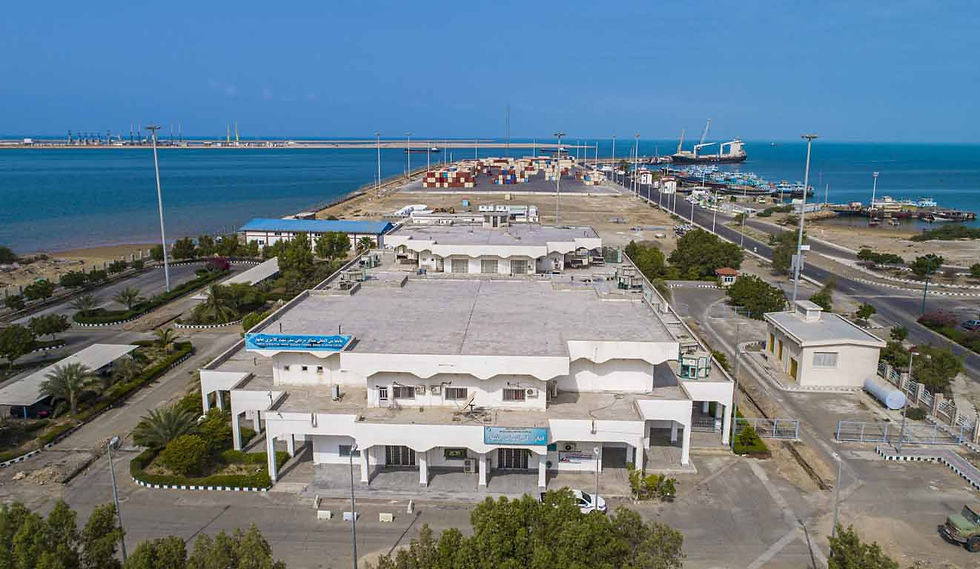
India Ports Global Limited and Iran's Ports and Maritime Organization signed a long-term contract covering the Shahid Beheshti terminal.
Under the agreement, India undertook to equip and operate the general cargo and container terminal for 10 years.
The Indian government described Chabahar as an India-Iran flagship project and a potential regional connectivity hub.
India had allocated ₹400 crore between FY2016-17 and FY2023-24, of which ₹201.51 crore had been utilised by July 2024, according to the Ministry of Ports, Shipping and Waterways.
The government's latest parliamentary disclosure adds another important figure.
India said in February 2026 that it had fulfilled its commitment to contribute $120 million for port equipment, with the final tranche transferred on August 26, 2025.
What Does Chabahar Give India?
Chabahar has several potential strategic and economic functions.
Access to Afghanistan
The port gives India an alternative route for moving goods towards Afghanistan without requiring transit through Pakistan.
This has both commercial and humanitarian significance.
Gateway to Central Asia
Countries such as Uzbekistan, Kazakhstan, Turkmenistan, Tajikistan and Kyrgyzstan are potentially important markets and partners for India.
But physical connectivity has historically constrained trade.
Chabahar could form part of a wider network linking Indian maritime trade with continental Central Asia.
A foothold in regional connectivity
Chabahar also gives India a role in building infrastructure beyond its immediate neighbourhood.
The Indian government has described the 2024 agreement as strengthening Chabahar's position as a gateway to Afghanistan and the wider Central Asian region.
Chabahar's Strategic Advantage: It Is Outside the Strait of Hormuz
There is another geographic feature that deserves particular attention.
Chabahar lies on the Gulf of Oman side of Iran, rather than inside the Persian Gulf.
India's government has previously noted that its location on the Arabian Sea allows Chabahar to avoid some of the challenges associated with developments in the Persian Gulf and the Strait of Hormuz.
This connects directly with our previous Updated+ explainer on the Strait of Hormuz.
The two stories should therefore be internally linked.
Chabahar and the International North-South Transport Corridor
Chabahar is also discussed in the broader context of India's plans to improve connectivity towards Eurasia.
One important initiative is the International North-South Transport Corridor (INSTC), a multimodal transport network involving sea, rail and road connections.
The larger strategic concept is straightforward:
India wants more than one route connecting its economy with Iran, Central Asia, Russia and Eurasian markets.
Chabahar can potentially complement those connectivity ambitions.
However, it is important not to present Chabahar and the INSTC as if they were a single completed corridor. Their infrastructure, routes and institutional arrangements are distinct, even though they can complement each other.
What Happened to Chabahar in 2025-26?
This is the section that will make the Updated+ article different from many older Chabahar explainers still appearing in search.
The geopolitical environment changed significantly.
According to India's Ministry of External Affairs, the U.S. State Department revoked in September 2025 the sanctions exception that had existed since 2018 for activities linked to Afghanistan's reconstruction and economic development.
The change became effective on September 29, 2025.
Following discussions with Washington, a conditional sanctions waiver was extended until April 26, 2026, the Indian government told Parliament.
After that deadline, India said the issue remained under discussion with both Iran and the United States.
As of early August 2026, India and Iran were reported to remain in negotiations concerning management of Chabahar.
This means the long-term strategic logic behind Chabahar remains important, while the precise operational and sanctions framework is still evolving.
Chabahar Timeline
Did India Lose Chabahar Port?
This question deserves a direct answer because readers may encounter conflicting claims online.
It is too simplistic to say that India simply “lost Chabahar.”
India signed a 10-year contract in 2024 and subsequently fulfilled its $120 million equipment commitment. But changes in the U.S. sanctions framework created serious legal and diplomatic complications for India's continued involvement.
The situation remained under negotiation in 2026.
That distinction matters.
A sanctions complication, an operational change, a temporary waiver and abandonment of an entire strategic project are not the same thing.
Was Chabahar Port Damaged in the 2026 Conflict?
There was also confusion during the 2026 West Asia conflict.
In July, India's Ministry of External Affairs clarified that the India-associated Chabahar terminal had not been damaged, contradicting reports suggesting it had been hit.
For a geopolitical explainer, this is worth including because readers searching for Chabahar in 2026 may encounter conflicting reports.
Chabahar vs Gwadar: Are They Rival Ports?
This comparison appears frequently in geopolitical discussions.
Pakistan's Gwadar Port and Iran's Chabahar Port sit on the wider Arabian Sea region and are separated by a relatively short geographic distance.
Gwadar is closely associated with Pakistan-China connectivity and the China-Pakistan Economic Corridor.
Chabahar has been developed through Iran's cooperation with India and other partners.
That has encouraged descriptions of the ports as geopolitical competitors.
But the reality is more complicated.
Ports are commercial infrastructure as well as strategic assets. Their success depends on cargo volumes, road and rail connectivity, regional stability, financing and trade demand.
Therefore, describing Chabahar simply as “India's answer to Gwadar” risks reducing a complex connectivity project to a geopolitical slogan.
Chabahar vs Gwadar
Why Chabahar Matters to Afghanistan
Afghanistan is landlocked.
That makes access to reliable seaports particularly important for its trade and humanitarian supply routes.
Chabahar offers one potential connection between Afghanistan and the Arabian Sea through Iran.
For India, this matters because Pakistan's geography has historically constrained direct overland connectivity between India and Afghanistan.
Chabahar therefore creates an alternative framework:
India → Iran → Afghanistan
rather than depending entirely on:
India → Pakistan → Afghanistan
This does not automatically make the route cheaper or easier. Infrastructure, border procedures, security and sanctions can all affect its commercial viability.
But strategically, it gives India another option.
Why Central Asia Matters to India
Central Asia has significant energy resources, minerals and growing markets.
India also has longstanding diplomatic and cultural ties with the region.
Yet trade remains constrained by geography.
Unlike China or Russia, India does not share a direct land border with Central Asia.
Improved connectivity through Iran could therefore help India pursue greater trade and economic engagement with the region.
This is why Chabahar should be understood as part of a connectivity strategy, rather than merely as an Iranian port investment.
What Could Stop Chabahar From Reaching Its Potential?
Chabahar has considerable strategic potential, but several obstacles remain.
Sanctions: Iran-related U.S. sanctions create financial and operational uncertainty.
Regional instability: Conflict can affect shipping, insurance and investment.
Infrastructure: A port alone is insufficient; efficient railways, roads and border connections are also required.
Commercial viability: Trade corridors ultimately need sufficient cargo volumes to become economically sustainable.
Diplomacy: India must balance relationships with Iran, the United States, Gulf countries and other regional powers.
The Chabahar project therefore illustrates the difference between strategic potential and commercial execution.
Why Chabahar Still Matters to India in 2026
The central logic behind Chabahar has not disappeared.
India still needs reliable connectivity with Afghanistan and Central Asia.
Pakistan still geographically separates India from the most direct overland route towards those regions.
And Iran remains one of India's possible gateways into continental Eurasia.
What has changed is the geopolitical environment surrounding the project.
The U.S. sanctions question has made Chabahar harder to manage, while regional conflict has added another layer of uncertainty.
This makes Chabahar not less relevant as a story, but more relevant.
It demonstrates how infrastructure, geography, trade and great-power politics intersect.
Chabahar Port and India: Key Takeaways
Chabahar Port gives India a potential maritime gateway through Iran towards Afghanistan and Central Asia without depending on Pakistan.
India Ports Global Limited signed a 10-year agreement in May 2024 to equip and operate the Shahid Beheshti terminal.
India subsequently completed its $120 million commitment for port equipment, according to the government.
However, the U.S. revoked the earlier sanctions exception in 2025. A conditional waiver ran until April 26, 2026, after which India continued discussions with Iran and Washington.
The project therefore sits at the intersection of four Indian priorities:
Trade. Connectivity. Energy and economic diplomacy. Strategic autonomy.
Chabahar's future will depend not only on what India and Iran want to build, but also on sanctions, regional stability and whether the wider transport corridors connecting the port become commercially viable.
That is why this relatively small port on Iran's Gulf of Oman coast remains an important piece of India's geopolitical map.


