
Al-Qaeda in Africa: Why the Sahel Has Become a New Centre of Jihadist Violence

For much of the world, Al-Qaeda is still associated with Afghanistan, Pakistan and the attacks of September 11, 2001.
But the geography of the organisation has changed.
Today, one of the most consequential centres of Al-Qaeda-linked militant activity lies thousands of kilometres away in Africa's Sahel ,the vast belt of semi-arid territory running south of the Sahara.
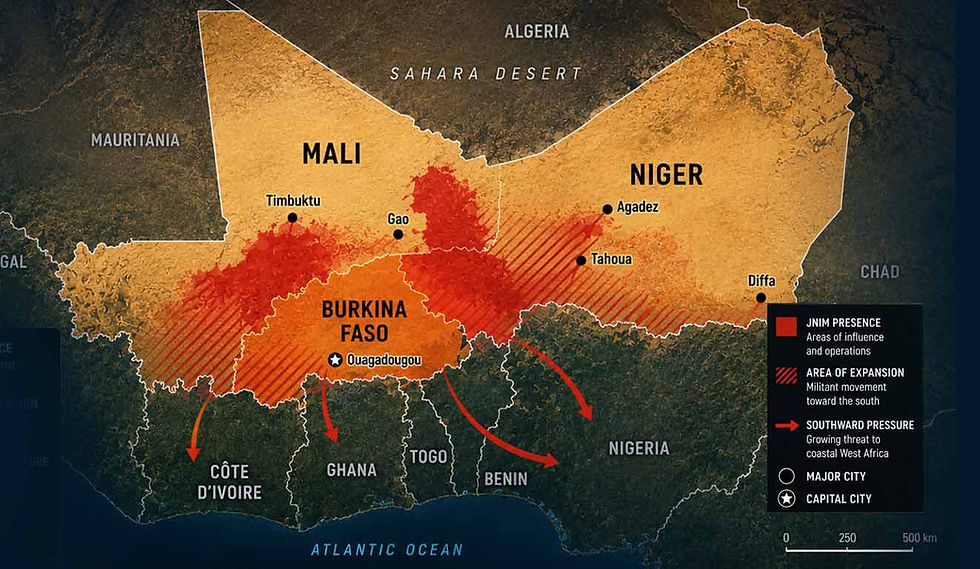
Across Mali, Burkina Faso and Niger, armed groups aligned with Al-Qaeda have expanded their presence, exploited weak state control and embedded themselves in local conflicts. Increasingly, their reach is also pushing south toward the coastal states of West Africa.
The United Nations' February 2026 assessment described terrorism in West Africa and the Sahel as a major concern, saying both Al-Qaeda and Islamic State affiliates had made significant gains. It specifically reported continued expansion by Jama'at Nusrat al-Islam wal-Muslimin, or JNIM, toward coastal states and north-western Nigeria.
The result is an important transformation:
Al-Qaeda's centre of operational gravity is no longer defined only by Afghanistan or the Middle East. Parts of Africa have become central to the network's survival and expansion.
Al-Qaeda in Africa: Why the Sahel Matters
The Sahel stretches across Africa from the Atlantic Ocean toward the Red Sea.
But the current militant crisis is concentrated particularly in the western Sahel.
Three countries sit at its centre:
Mali. Burkina Faso. Niger.
Years of insurgency, political instability, military coups, weak state institutions, porous borders and unresolved local conflicts have created an environment in which militant organisations can operate across enormous territories.
The Africa Center for Strategic Studies assessed in 2025 that the Sahel had been Africa's most lethal theatre of militant Islamist violence for four consecutive years. It estimated that the region accounted for 55% of militant Islamist-linked fatalities across Africa during the period it analysed.
The violence is no longer confined to remote desert regions.
Militant networks have increasingly pushed toward population centres, transportation routes and economically important borderlands.
What Is JNIM?
At the heart of Al-Qaeda's expansion in the Sahel is Jama'at Nusrat al-Islam wal-Muslimin, commonly known as JNIM.
JNIM was created in 2017 when several militant organisations operating in Mali merged.
These included:
Ansar al-Din
Al-Murabitun
the Macina Liberation Front
AQIM's Sahara branch
JNIM's leader, Iyad ag Ghali, pledged allegiance through Al-Qaeda's organisational hierarchy when the coalition was formed. The US National Counterterrorism Center describes JNIM as an Al-Qaeda-aligned organisation that exploits local grievances while seeking to expand its influence across West Africa.
The United States designated JNIM a Foreign Terrorist Organization in 2018.
But describing JNIM simply as a branch operating under direct orders from a distant Al-Qaeda headquarters can be misleading.
Its strength comes partly from its local character.
Different JNIM components operate in different regions, build relationships with communities, exploit local disputes and adapt their rhetoric to local conditions.
That makes the organisation more resilient than a conventional centrally controlled militant group.
From AQIM to JNIM
Al-Qaeda's African presence did not begin with JNIM.
Its origins in North Africa can be traced through the Salafist Group for Preaching and Combat, an Algerian militant organisation that aligned itself with Al-Qaeda in 2006 and became Al-Qaeda in the Islamic Maghreb - AQIM in 2007.
AQIM later developed extensive operations in the Sahara and Sahel.
Internal splits and alliances eventually produced several organisations, some of which later merged to create JNIM.
US intelligence has described AQIM as an Al-Qaeda affiliate that nevertheless maintained a largely autonomous command structure and targeting strategy.
That model - ideological alignment combined with substantial local autonomy — would become a defining feature of Al-Qaeda's wider network.
Why Has JNIM Expanded So Rapidly?
There is no single explanation.
The Sahel crisis is the product of overlapping political, social and security failures.
Militant organisations have exploited those failures.
Weak State Presence
Large parts of Mali, Burkina Faso and Niger contain remote rural communities where governments have historically provided limited security and public services.
When state authority is weak, armed organisations can fill parts of the vacuum.
They may impose their own rules, mediate disputes, collect money or threaten communities into cooperation.
This does not mean local populations necessarily support their ideology.
In many cases, survival and coercion matter more than ideological commitment.
Local Grievances
JNIM has repeatedly sought to exploit conflicts involving land, ethnicity, political exclusion and competition over local resources.
The US National Counterterrorism Center notes that JNIM exploits local divisions and grievances in order to expand its support.
That strategy is important.
A global jihadist ideology becomes much more effective when militants connect it to disputes that already exist locally.
Security Force Abuses
Another factor is the behaviour of state security forces and allied armed groups.
Civilian abuses can create anger and distrust toward governments.
The Africa Center has assessed that abuses against civilians, including communities perceived to be associated with militant groups, have become an important driver exploited by JNIM for recruitment and propaganda.
JNIM has used those grievances to portray itself as a defender of marginalised communities.
The reality on the ground is more complicated: the organisation itself has also been responsible for attacks against civilians, kidnappings and coercion.
Burkina Faso: The Epicentre of the Crisis
Burkina Faso has become one of the most severely affected countries.
Militant violence expanded dramatically after spreading south from Mali.
The Africa Center assessed that Burkina Faso accounted for the largest share of Sahelian militant Islamist-linked fatalities in 2024 and described it as the principal centre of such violence in the region since 2019.
JNIM-linked groups have established influence across large rural areas and repeatedly attacked military positions and communities.
The conflict has displaced millions of people across the wider Sahel.
This illustrates a central problem facing governments:
Militants do not necessarily need to control major capitals to undermine state authority.
They can instead contest rural territory, transportation corridors and economically important border areas.
Mali: From Northern Insurgency to a Wider Conflict
Mali was the original centre of the modern Sahel insurgency.
The country's 2012 crisis allowed multiple armed organisations to seize territory in the north.
A French-led military intervention pushed militants out of major northern cities in 2013.
But the insurgency did not disappear.
Instead, armed networks dispersed and increasingly expanded into central and southern Mali.
By 2025, JNIM-linked organisations were demonstrating a growing capacity to strike transportation routes and economically important areas in western Mali.
The Africa Center reported that attacks against transport routes and fuel supplies had increasingly put pressure on Bamako and southern Mali.
The conflict was no longer simply a northern desert insurgency.
It had become a national security crisis.
Niger: A Second Front
Neighbouring Niger faces a different but connected threat.
JNIM operates in parts of the country, while Islamic State in the Sahel is also active.
The two networks compete for territory and influence.
US travel guidance currently identifies JNIM and Islamic State-linked organisations among the terrorist groups operating in Niger and notes that kidnapping for ransom remains part of militant financing activity.
The security environment deteriorated further following Niger's 2023 military coup.
Africa Center analysis found that militant Islamist-linked fatalities increased sharply after the coup, particularly as armed groups intensified attacks on security forces and border communities.
Al-Qaeda vs Islamic State in the Sahel
The Sahel is not controlled by one militant organisation.
Al-Qaeda-linked JNIM and Islamic State-linked groups are rivals.
Their relationship can vary by location and period.
In some areas they compete for territory, recruits and economic resources.
In others, local arrangements can be more fluid.
Recent Africa Center reporting describes increased competition and clashes between JNIM and Islamic State in the Sahel in western Burkina Faso and northern Mali.
That rivalry adds another layer to the conflict.
Governments are not fighting a single unified insurgency.
They are dealing with overlapping militant networks, criminal organisations and local armed actors.
How Does JNIM Finance Itself?
JNIM's financial model is also highly localised.
The US State Department says the organisation receives funding through:
kidnapping for ransom, extortion, smugglers and trafficking networks.
Territorial influence can also create financial opportunities.
Groups that dominate transport routes or local economies can extract payments.
Kidnapping remains especially important.
This model reduces dependence on Al-Qaeda's senior leadership outside Africa.
JNIM can generate resources inside the conflict zone.
That financial independence is one reason regional affiliates can remain operational even when Al-Qaeda's central leadership is weakened.
The Push Toward Coastal West Africa
Perhaps the most strategically important trend is JNIM's movement south.
The conflict was once concentrated primarily in Mali.
Then it spread deeply into Burkina Faso and parts of Niger.
Now northern Benin and Togo have become increasingly exposed.
The UN reported in February 2026 that JNIM remained active across Mali, Burkina Faso and Niger while continuing to expand south toward coastal states and north-west Nigeria. It also said a senior JNIM commander had been tasked with expanding the organisation's presence in Benin, Côte d'Ivoire, Ghana, Niger and Togo.
The Africa Center reported that northern Benin has become an important frontline as militant groups operating from Burkina Faso and Niger push into coastal West Africa.
This expansion matters because coastal states connect the Sahel to major ports, trade corridors and more densely populated regions.
Why Coastal West Africa Matters
Countries such as Benin, Togo, Ghana and Côte d'Ivoire have historically been considerably more stable than the central Sahel.
But their northern borderlands connect directly to the conflict zone.
Forested areas and protected parks spanning borders create difficult terrain for governments to monitor.
The W-Arly-Pendjari park complex, for example, spans areas around Benin, Burkina Faso and Niger and has become an important security concern.
Africa Center analysis says JNIM-linked networks have used areas in southeastern Burkina Faso to infiltrate Benin and Togo, while putting pressure on commercial corridors connecting the interior to coastal ports.
In 2026, the organisation's expansion had become sufficiently visible that analysts were discussing a broader militant theatre stretching from Mali toward western Nigeria.
The Role of Military Coups
The Sahel's security crisis has unfolded alongside major political upheaval.
Mali experienced military coups in 2020 and 2021.
Burkina Faso experienced two coups in 2022.
Niger's elected government was overthrown in 2023.
Each military takeover was justified in part by frustration over insecurity.
Yet militant violence has continued.
Africa Center analysis notes that militant Islamist-linked fatalities across the Sahel are now far higher than before the sequence of military coups began.
That does not mean coups alone caused the insurgency.
The crisis predates them.
But political instability, changing security partnerships and weakened regional cooperation have complicated the response.
Why Military Force Alone Has Not Solved the Problem
Governments have repeatedly attempted to defeat militant organisations through military operations.
Those operations can disrupt groups and kill commanders.
But the underlying problem is broader.
If governments cannot provide security, justice, economic opportunity and basic services, militants can return after military forces leave an area.
Civilian protection is especially important.
Heavy-handed counterterrorism operations that kill civilians can produce new grievances.
That means the Sahel conflict is simultaneously:
a military problem, a governance problem, a political problem and a development problem.
Treating it exclusively as counterterrorism risks addressing only one part of the crisis.
Where Al-Qaeda's Affiliates Operate Across Africa.
Has Africa Become Al-Qaeda's New Centre?
Not in the sense that every Al-Qaeda operation is now commanded from Africa.
Al-Qaeda remains a dispersed international network.
AQAP remains important in Yemen.
AQIS continues to exist in South Asia.
Senior Al-Qaeda leadership remains relevant to the movement's global ideological identity.
But operationally, Africa has become increasingly important.
JNIM is expanding across the Sahel.
Al-Shabaab remains deeply entrenched in Somalia.
Together, African affiliates represent some of the most powerful organisations associated with the wider Al-Qaeda network.
The Sahel's importance is therefore not symbolic.
It reflects where militant organisations are gaining territory, revenue, recruits and political influence.
The Bigger Question
The rise of Al-Qaeda-linked organisations in the Sahel illustrates how global terrorist networks can survive without controlling a single central headquarters.
They adapt.
They embed themselves in local conflicts.
They exploit political instability.
And they use regional affiliates to build influence far from the places where their movements first emerged.
For Al-Qaeda, Africa is no longer a peripheral battlefield.
It has become one of the places where the organisation's decentralised model is most visible — and where its affiliates have achieved some of their most significant gains.
The unanswered question is whether governments in the Sahel and coastal West Africa can contain that expansion before the conflict becomes even more deeply regional.
Also Read:
Editorial Sourcing Note
This article draws primarily on United Nations Security Council Monitoring Team reports, US National Counterterrorism Center and State Department records, and Africa Center for Strategic Studies research. Estimates of militant strength, territorial influence and casualties vary because independent reporting from parts of the Sahel remains limited.


